
Premium nail care and lash beauty services in the heart of Las Vegas.
Our location
4080 Paradise Rd, Suite 150, Las Vegas, NV 89169
Talk with us
Visit us online
- September 9, 2026
- By: Marvelous Nails & Lashes
- Blog
- nail shapes
- stiletto
- almond
- nail care
Stiletto, Almond or Coffin? Choosing a Nail Shape That Lasts
The real differences between stiletto, almond, coffin and squoval — how each breaks, what length each needs, and which suits your natural nail bed.
Table of Contents
- What Separates These Four Shapes?
- Stiletto vs Almond: The Comparison Most People Want
- Coffin, Squoval and the Rest of the Field
- How Each Shape Actually Breaks
- Matching a Shape to Your Own Nail Bed
- What Each Shape Needs From the System and the Budget
- Frequently Asked Questions
TL;DR
- Stiletto and almond both taper to a point; almond stops there and stiletto keeps going. Almond has a rounded apex, stiletto a sharp one.
- Coffin is a stiletto with the point cut flat. It needs the same length as stiletto but distributes stress far better.
- Shape decides where a nail breaks, not whether it breaks. Every shape has a predictable failure point.
- Your nail bed matters more than the trend. Short, wide beds fight long tapered shapes and win.
- A short almond in a plain finish outclasses a long set in a busy design in almost every photograph.
If you are searching `stiletto nails`, `difference between stiletto and almond nails` or `medium nail shapes`, you are choosing between shapes that look similar in a photo and behave completely differently on a hand. This is the practical comparison.
What Separates These Four Shapes?
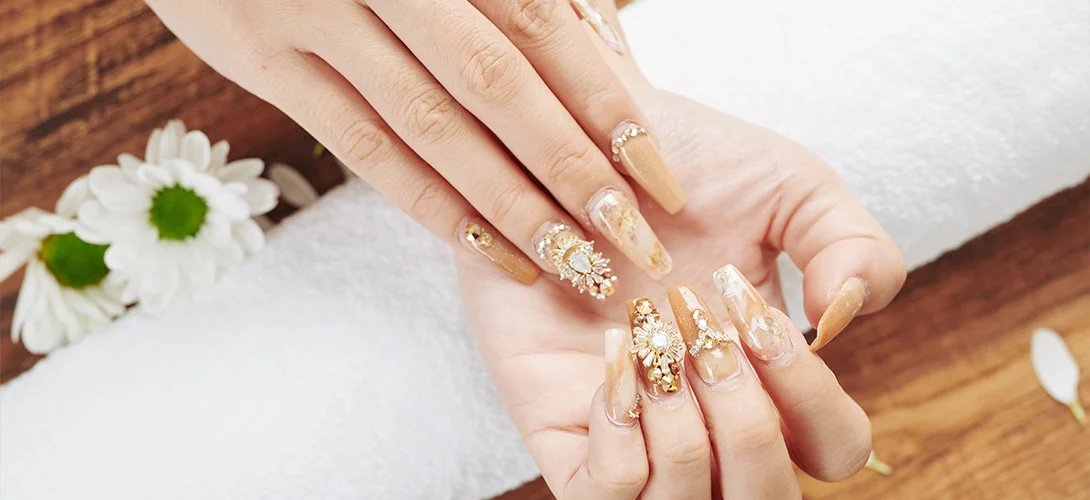
Nail shapes differ on two variables: how much the sides taper inward, and how the free edge is finished. Squoval has no taper and a flat edge. Almond tapers moderately to a soft rounded point. Stiletto tapers sharply to a fine point. Coffin tapers like a stiletto but the point is cut flat, leaving a narrow straight edge. Everything else — how long each needs to be, how it breaks, which hands it flatters — follows from those two variables.
The single most useful rule: the more a shape tapers, the more length it needs to look intentional, and the more length it has, the more leverage acts on the nail. Taper and durability pull in opposite directions.
1. Stiletto vs Almond: The Comparison Most People Want
| Almond | Stiletto | |
|---|---|---|
| Taper | Moderate | Sharp |
| Tip | Rounded, soft point | Fine, sharp point |
| Minimum length that works | Short to medium | Medium to long |
| Everyday practicality | High | Low |
| Breaks at | The tip, cleanly | The side wall, near the stress point |
| Photographs as | Elegant, elongating | Dramatic, high-fashion |
| Good first shape? | Yes | No |
The difference in one sentence: almond is a taper that stops, stiletto is a taper that keeps going. Almond rounds off at the point; stiletto sharpens to it. That single change is what turns a wearable everyday shape into a statement one.
Why almond is the more forgiving of the two. The rounded tip has no sharp corner to catch, so it does not snag on fabric, hair or a car door handle. It also works at short length, which stiletto genuinely does not — a short stiletto reads as a chipped almond rather than a deliberate shape.
Why people choose stiletto anyway, and when it is right. It elongates the hand more than any other shape and is unmatched for a photographed event. If you are going stiletto, go for an occasion rather than as your default, and expect to change how you use your hands for the duration.
A middle option worth knowing about: a "soft stiletto" — the same taper with the point slightly blunted. It keeps most of the drama and removes the worst of the snagging.
2. Coffin, Squoval and the Rest of the Field
Coffin (also called ballerina) is a stiletto with the point cut flat. That flat edge is doing real structural work: it removes the single most fragile part of a stiletto and gives the tip a straight edge that resists side impact. It needs medium-to-long length to look right — a short coffin looks like a mistake.
Squoval is a square with the corners softened. It is the most durable of the popular shapes because there is no taper concentrating stress on a narrow point, and it works at any length. It is also the least dramatic, which is exactly why it is the most common request for people who type all day.
Oval is almond without the point — the softest shape available and the strongest option at genuinely short length. It is under-requested and flattering on almost everyone.
Round is the shortest and simplest, following the natural curve of the fingertip. It is the shape dermatologists effectively describe: the American Academy of Dermatology advises to round the nails slightly at the tips for maximum strength.
The ranking by durability, most to least forgiving: round, oval, squoval, almond, coffin, stiletto.
Our nail shapes guide covers the full field, and the short and medium nail shapes guide focuses on what works below medium length.
3. How Each Shape Actually Breaks
Every shape has a predictable failure mode. Knowing yours tells you what to protect.
| Shape | Where it fails | What triggers it |
|---|---|---|
| Stiletto | Side wall, near the stress area | Sideways force — opening a door, pulling a zip |
| Coffin | Corners of the flat tip | Catching the corner on a bag or pocket |
| Almond | The tip itself | Direct downward pressure |
| Squoval | Free-edge corners | Snagging, though rarely severe |
| Oval / round | Rarely fails structurally | Usually just wears down |
The pattern: taper concentrates stress. A stiletto carries the same force as a squoval through a much narrower cross-section, which is why it breaks at the side wall rather than the tip.
What this means practically. If you want length and taper, the build matters more than the colour. A properly placed apex over the stress area is the difference between a stiletto that lasts three weeks and one that snaps in four days. Our broken nail repair guide covers what happens next when one does go.
And the thing that causes more breaks than any shape choice: treating nails as tools. Opening cans, scraping labels and prising lids are what turn a well-built set into a repair appointment.
4. Matching a Shape to Your Own Nail Bed
The shape that suits you is largely decided by anatomy, not by what looked good on someone else.
Short, wide nail beds. Tapered shapes fight you here — a taper on a wide bed either looks stubby or requires a lot of added length. Almond and oval work well because they create the illusion of length without needing much. Squoval is the safe default.
Long, narrow nail beds. Almost everything works. Squoval and coffin look particularly good because there is bed length to fill. Stiletto is genuinely wearable on this shape.
Curved nails (a pronounced C-curve from side to side). Almond and oval follow the curve naturally. Flat-edged shapes like squoval and coffin can look slightly at odds with it.
Flat nails. Squoval and coffin sit naturally. Almond needs a careful build to avoid looking flat and wide at the same time.
Wide fingertips. Taper helps — almond or oval narrows the visual line. Square shapes emphasise width.
The honest advice most salons will not volunteer: if you are unsure, start one step shorter and one step less tapered than you think you want. Filing a shape down at the next appointment is free; growing length back is not.
5. What Each Shape Needs From the System and the Budget
Long tapered shapes are not just an aesthetic choice — they need a system that can carry them.
| Shape | Works on natural nails? | Suits which system | Our price |
|---|---|---|---|
| Round / oval | Yes | Gel manicure is plenty | $58 |
| Squoval | Yes, at short length | Gel, soft gel, any enhancement | $58+ |
| Almond | At short length only | Gel-X, hard gel, poly gel for length | $80+ full set |
| Coffin | No | Gel-X, hard gel, poly gel, acrylic | $80+ full set |
| Stiletto | No | Hard gel or acrylic for strength | $80+ full set |
Hard gel earns its place on this list. It is the strongest of the systems we offer for carrying length under taper, at $80 and up for a full set. The trade-off is that it does not dissolve in acetone — it has to be filed off. Our hard gel guide and builder gel and hard gel guide cover that in full.
Gel-X is the better choice if you want length with a clean exit. Full set $80 and up, fill $70 and up, and it soaks off. Our Gel-X guide covers when it suits.
Budget for the maintenance, not just the set. Any tapered length needs a fill every two to three weeks — our how often should you get a fill guide has the intervals per system. The full price guide has the rest of the menu.
Frequently Asked Questions
What is the difference between stiletto and almond nails?
Both taper toward the tip. Almond stops at a soft rounded point; stiletto continues to a sharp one. Almond works at short length and is far more practical day to day; stiletto needs medium-to-long length and snags easily.
How long do stiletto nails need to be?
Medium to long — at least several millimetres past the fingertip. A short stiletto does not read as a deliberate shape, because there is not enough length for the taper to resolve into a point.
Which nail shape is strongest?
Round and oval, followed by squoval. Taper concentrates stress into a narrow cross-section, so the more tapered a shape is, the more likely it is to fail under sideways force.
What are the best medium-length nail shapes?
Almond, squoval and coffin all work well at medium length. Almond is the most flattering across different hand types, squoval the most durable, and coffin the most dramatic without going full stiletto.
Is coffin the same as ballerina?
Yes, they are two names for the same shape — a taper like a stiletto with the point cut flat, leaving a narrow straight free edge.
What is a soft stiletto?
A stiletto with the sharp point slightly blunted. It keeps most of the elongating effect while removing the corner that catches on fabric and hair, which is the main practical complaint about a true stiletto.
Which nail shape suits short, wide nail beds?
Almond and oval, because a moderate taper creates the illusion of length without requiring much added length. Squoval is the safe default. Avoid long stiletto and coffin, which need bed length you do not have.
Can I change shape at a fill appointment?
Minor adjustments yes, a genuine change no. Going from coffin to almond removes structure that has to be rebuilt, so that is a full set rather than a fill.
Do sharper shapes damage the natural nail more?
Not directly, but they break more often, and a break that takes part of the natural nail with it does cause damage. The bigger factor is that longer, more tapered sets tend to be worn continuously without breaks.
Which shape photographs best?
Almond, at medium length, in a high-gloss finish. It elongates the hand without dominating the frame, and gloss reads as well-done in a photo far more reliably than any particular colour does.
Not Sure Which Shape Suits Your Hands?
Bring a photo of what you like and we will tell you honestly whether your nail bed will carry it, and what the nearest shape is that will.
Marvelous Nails & Lashes, 4080 Paradise Rd, Suite 150, Las Vegas, NV 89169. Open Monday–Saturday 10:00 AM–10:00 PM, Sunday 10:00 AM–7:00 PM. Book online, call (702) 550-8855, or contact us.
Sources:
- American Academy of Dermatology — 10 tips for healthy nails, accessed 2026-09-07
- American Academy of Dermatology — How to reduce nail damage from artificial nails, accessed 2026-09-07

Marvelous Nails & Lashes
Our Las Vegas nail and lash team shares practical beauty guidance, salon care tips, and service recommendations for healthier, longer-lasting results.