
Premium nail care and lash beauty services in the heart of Las Vegas.
Our location
4080 Paradise Rd, Suite 150, Las Vegas, NV 89169
Talk with us
Visit us online
- September 10, 2026
- By: Marvelous Nails & Lashes
- Blog
- russian manicure
- manicure
- nail care
- las vegas
Russian Manicure vs Regular Manicure: The Honest Comparison
What a Russian manicure actually does differently, whether it hurts, what dermatologists say about cuticle work, and who should choose a regular manicure.
Table of Contents
- What Is a Russian Manicure?
- The Actual Difference, Step by Step
- Does It Hurt, and Is It Safe?
- What Dermatologists Say About Cuticle Work
- Cost, Time and How Long Each Lasts
- Which One You Should Actually Book
- Frequently Asked Questions
TL;DR
- A Russian manicure is a dry manicure done with an electric file instead of water and nippers. That is the entire difference in method.
- The visible result is a polish line that sits flush against the skin, which is why it photographs so well and why it looks grown-out later than a regular set.
- It should not hurt. Pain, bleeding or stinging afterwards means it went too deep.
- Dermatologists advise against removing the cuticle, and the Russian technique gets closest to that line — technician skill is the whole safety margin.
- A regular manicure is the right choice for most people. Ours is $38 classic, $58 gel, $65 Marvelous.
`Russian manicure`, `russian manicure near me`, `does a russian manicure hurt` and `are russian manicures safe` are among the most-searched nail questions in Las Vegas, and the answers online are split between people selling it and people warning against it. Here is the version with the dermatology position included.
What Is a Russian Manicure?
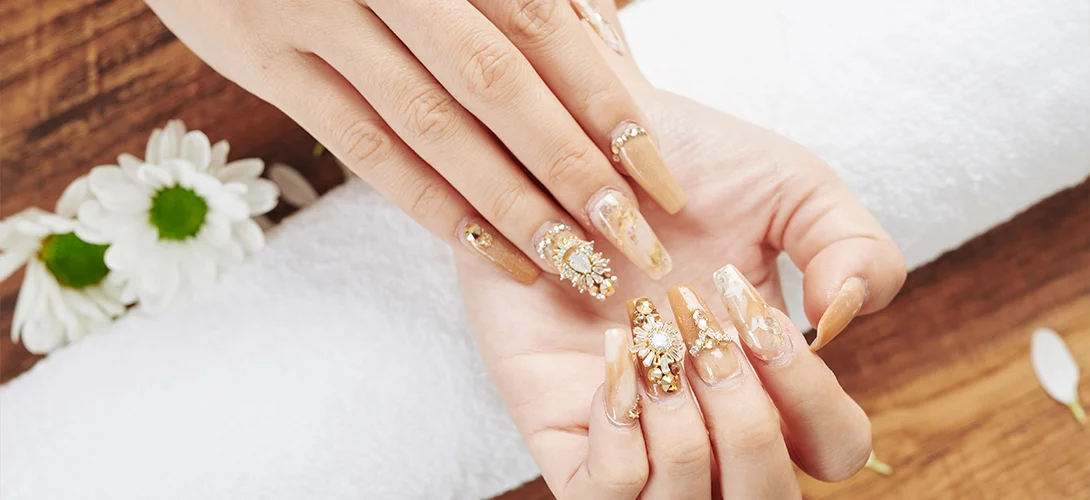
A Russian manicure is a dry manicure technique in which the nail is prepared with a small electric file and specialised bits rather than with water soaking and metal nippers. The technician lifts and clears the non-living tissue at the base of the nail so that colour can be applied right up to the skin line. The result is a polish edge that sits flush against the cuticle, which reads as cleaner and appears to grow out more slowly.
It is a method, not a product. You can have a Russian-technique preparation and then finish with gel, with regular polish or with an enhancement on top. The name describes how the nail was prepped, nothing else.
1. The Actual Difference, Step by Step
| Regular manicure | Russian manicure | |
|---|---|---|
| Soaking | Hands soaked in water first | Dry throughout — no water |
| Cuticle work | Softened, pushed back, trimmed with nippers | Lifted and cleared with a rotating file bit |
| Tools | Pusher, nippers, files | Electric file with a range of small bits |
| Where colour stops | A hair's width from the skin | Flush against the skin line |
| Time | 30–60 minutes | Typically 60–90 minutes |
| Skill dependence | Moderate | Very high |
| Regrowth visible after | About a week | Often closer to two |
The reason the polish line matters: with a regular manicure, the colour has to stop slightly short of the skin to avoid flooding the cuticle. That small gap plus normal nail growth becomes a visible band of bare nail within about a week. A Russian prep starts flush, so the same amount of growth is less obvious for longer.
The reason the technique is riskier: an electric file spinning next to living skin has no margin for a slip. In a regular manicure the worst outcome of a heavy hand is usually a nicked cuticle. With a rotating bit the same mistake can thin the nail plate or open the seal between nail and skin.
Our Russian manicure page covers what the service involves at our salon, and Gel-X and Russian manicure trends covers why both took off at the same time.
2. Does It Hurt, and Is It Safe?
A correctly performed Russian manicure does not hurt. You should feel vibration and warmth, nothing more. The bit is working on non-living tissue.
What means it went too far:
- Sharp pain during the work. Stop and say so.
- Bleeding, at any point.
- Stinging when you wash your hands that evening.
- Redness or swelling around the nail base a day later.
- A visible dip or thin patch in the nail plate near the cuticle.
Any of those is a technique problem, not a normal part of the service. The most common cause is a technician working too fast, too deep, or with the wrong bit.
The infection question is the serious one. The cuticle is a seal. Break it and you have created an entry point. The American Academy of Dermatology is direct about this: never cut or forcefully push back your cuticles, because doing so exposes the space between nail and skin. The AAD also notes that once you have had one nail infection, you are more likely to get another — so the first one is worth avoiding.
What to check before you sit down, regardless of technique: tools out of a sealed pouch, a clean workstation, and a licence displayed. Nevada requires that instruments be cleaned and disinfected before each use under NAC 644A.740, and that every licensee wash their hands with liquid soap before and after serving each client under NAC 644A.765. Our clean salon checklist and how to check a licence cover the rest.
3. What Dermatologists Say About Cuticle Work
This is the part usually missing from Russian manicure content, so it is worth stating plainly.
The dermatology position is not neutral. The AAD's guidance is that cuticles should not be cut or forced back at all, because the cuticle's function is to seal the gap where bacteria and fungus would otherwise enter. A Russian manicure works closer to that seal than any other common technique.
That does not make it forbidden. It makes the distinction between removing dead tissue at the edge and cutting into living skin the entire safety question — and that distinction lives in the technician's hands, not in the method.
The practical reading:
- If your cuticles are healthy and you want the flush look, a skilled technician can deliver it.
- If you are prone to hangnails, inflammation or infection, choose a regular manicure with oil-based cuticle care instead.
- If you are diabetic, immunocompromised, or on medication that slows healing, ask your doctor first and default to the gentler option.
The product side matters too. The FDA notes that with artificial nails, traces of methacrylate monomers remain after artificial nails are formed, and that it is important to avoid contact with the skin in order to minimize the chance of an allergic reaction. A flush-to-the-skin application makes that contact more likely, not less — which is an argument for a careful hand rather than an argument against the service.
4. Cost, Time and How Long Each Lasts
| Service | Our price | Time | Colour stays neat for |
|---|---|---|---|
| Classic manicure | $38 | 30–45 min | 3–5 days (regular polish) |
| Gel manicure | $58 | 45–60 min | 2–3 weeks |
| Marvelous manicure | $65 | 60–75 min | 2–3 weeks with gel |
| Soft gel manicure | $58+ (soak-off included) | 60–75 min | 2–3 weeks |
| Russian manicure | Quoted in person | 60–90 min | 3–4 weeks before regrowth shows |
We quote the Russian manicure at the appointment rather than publishing a number, because the work varies enormously with the state of the nail and how much preparation is needed. Ask on the phone and we will give you a range before you come in.
Where the extra time goes: almost all of it is the preparation. The colour application is the same either way.
The value calculation is honest either way. A Russian manicure costs more and takes longer, and buys you roughly one extra week before the regrowth line becomes obvious. If you rebook every two weeks regardless, that week is worth very little. If you stretch to four, it is worth a lot. Our Las Vegas nail prices guide has the full menu, and the gel manicure guide breaks down what drives the difference between the tiers.
5. Which One You Should Actually Book
Book a Russian manicure if:
- You want the flush polish line specifically, and you have seen the technician's work.
- Your nails and cuticles are healthy with no history of infection or inflammation.
- You are stretching four weeks between appointments and the extra tidiness pays for itself.
- You are being photographed and hands are in the frame.
Book a regular manicure if:
- It is your first time at a new salon and you have not seen the work yet.
- You get hangnails, split skin or inflammation around the nails.
- You have any healing-related health condition.
- You rebook every two weeks anyway.
- You would rather spend the difference on the colour, the shape or a pedicure.
The honest recommendation for most people is the regular manicure, done well, with oil afterwards. A $58 gel manicure with a clean cuticle line and a good finish photographs beautifully and carries no added risk.
And the rule that applies to both: the technician matters more than the technique. A careful hand doing a regular manicure will always beat a rushed hand doing a Russian one.
Frequently Asked Questions
What is a Russian manicure?
A dry manicure done with a small electric file rather than water soaking and nippers. The technician clears non-living tissue at the nail base so colour can be applied flush against the skin line. It is a preparation method, not a product.
What is the difference between a Russian manicure and a regular manicure?
A regular manicure soaks the hands and trims the cuticle with nippers, stopping the colour just short of the skin. A Russian manicure is dry, uses a rotating file, and takes the colour right to the skin line. The Russian version takes 60 to 90 minutes instead of 30 to 60.
Does a Russian manicure hurt?
It should not. You should feel vibration and warmth only. Sharp pain, bleeding, or stinging when you wash your hands afterwards means the work went too deep and is a technique problem, not a normal part of the service.
Are Russian manicures safe?
They can be, in skilled hands, but they carry more risk than a regular manicure. Dermatologists advise never cutting or forcefully pushing back cuticles, because the cuticle seals the nail against infection — and the Russian technique works closest to that seal.
How long does a Russian manicure last?
The colour lasts as long as whatever finish is applied — two to three weeks for gel. What differs is that regrowth stays less visible, often out to three or four weeks, because the colour started flush against the skin.
How much is a Russian manicure in Las Vegas?
We quote it in person because the amount of preparation varies a great deal between clients. Our published manicure prices are $38 classic, $58 gel and $65 Marvelous, and the Russian technique sits above those. Ask for a range when you call.
Who should not get a Russian manicure?
Anyone prone to hangnails, inflammation or nail infections, anyone diabetic or immunocompromised, and anyone on medication that slows healing. A regular manicure with oil-based cuticle care is the better choice in all of those cases.
Can I get a Russian manicure with gel or extensions?
Yes. The Russian technique describes the preparation, so it can be finished with regular polish, gel, or an enhancement built on top. Ask for the total including whatever finish you want.
Is a Russian manicure worth the extra cost?
It is if you stretch four weeks between appointments, because the tidier regrowth genuinely buys you time. It is not if you rebook every two weeks, because you would replace the set before the difference shows.
Ask Us Which One Suits Your Nails
Bring us your hands and we will tell you honestly which technique makes sense — including when the answer is the cheaper one.
Marvelous Nails & Lashes, 4080 Paradise Rd, Suite 150, Las Vegas, NV 89169. Open Monday–Saturday 10:00 AM–10:00 PM, Sunday 10:00 AM–7:00 PM. Book online, call (702) 550-8855, or contact us.
Sources:
- American Academy of Dermatology — Manicure and pedicure safety, accessed 2026-09-07
- American Academy of Dermatology — How to prevent another nail infection, accessed 2026-09-07
- U.S. Food and Drug Administration — Nail Care Products, accessed 2026-09-07
- Nevada State Board of Cosmetology — Salon Rules and Regulations (NAC 644A.740, NAC 644A.765), accessed 2026-09-07
Marvelous Nails & Lashes
Our Las Vegas nail and lash team shares practical beauty guidance, salon care tips, and service recommendations for healthier, longer-lasting results.