
Premium nail care and lash beauty services in the heart of Las Vegas.
Our location
4080 Paradise Rd, Suite 150, Las Vegas, NV 89169
Talk with us
Visit us online
- September 14, 2026
- By: Marvelous Nails & Lashes
- Blog
- lash care
- eyelash extensions
- aftercare
- las vegas
Lash Extension Aftercare: What Actually Makes a Set Last
Most lash sets fail on aftercare, not application. The first 24 hours, daily cleansing, what the FDA says about eye cosmetics, and habits that kill retention.
Table of Contents
- What Is Lash Extension Aftercare?
- The First 24 Hours
- Daily Cleansing: The One Habit That Decides Everything
- Products and Habits That Kill Retention
- Safety: What the FDA Says About Eye Cosmetics
- Aftercare in Las Vegas Specifically
- Frequently Asked Questions
TL;DR
- Aftercare, not application, is what separates a three-week set from a ten-day one.
- Keep the set completely dry for the first 24 hours while the adhesive finishes curing.
- Cleanse daily with a lash-safe cleanser. Skipping this is the single biggest cause of early shedding — and of irritation.
- Oil-based products near the eye break the bond. Check your cleanser, moisturiser and sunscreen.
- Stop using anything that causes irritation and see a doctor if it persists. That is the FDA's position, not just ours.
If you have just had a set done, or a previous set shed faster than you expected, the cause is almost always in this list rather than in the application. Here is the whole routine.
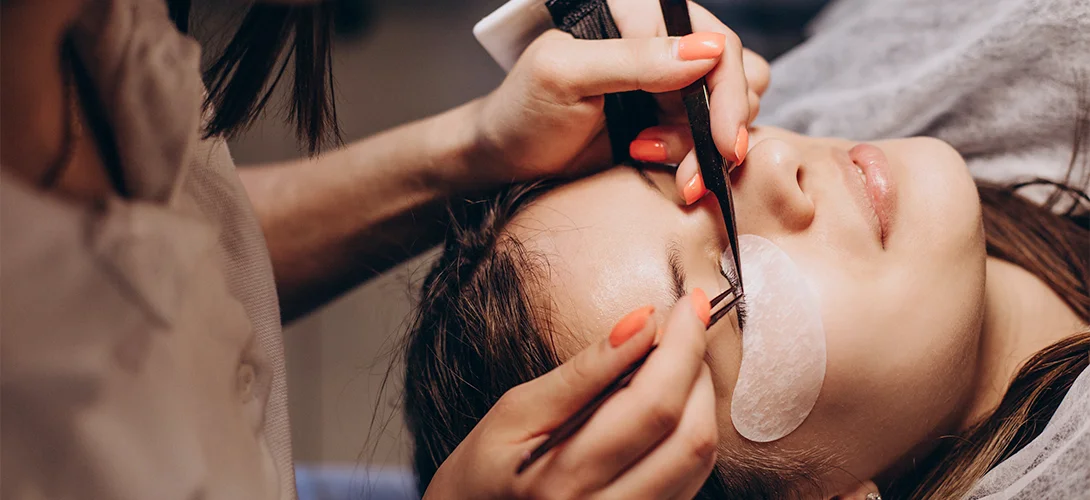
What Is Lash Extension Aftercare?
Lash extension aftercare is the daily routine that protects the adhesive bond between an extension and the natural lash it is attached to. It has three parts: keeping the set dry for the first 24 hours while the adhesive cures fully, cleansing the lash line daily with an oil-free lash cleanser to remove skin oil and debris, and avoiding the products and habits that break the bond — oil-based cosmetics, heat and steam, face-down sleeping, rubbing, and waterproof mascara. Done consistently, it is the difference between a set that reaches a three-week fill looking full and one that needs replacing at ten days.
The counterintuitive part: cleaning your lashes makes them last longer, not shorter. Most people assume the opposite and avoid touching them at all, which is precisely what causes early loss.
1. The First 24 Hours
Keep them completely dry. No water, no steam, no sweat on the lash line. The adhesive cures over this period and water during curing weakens the bond permanently.
That means, for the first day:
- No showering with your face under the water. Wash your body, keep your face out of the stream.
- No swimming, hot tub, sauna or steam room.
- No workout that will make you sweat around the eyes.
- No crying if you can help it, which is a real instruction and not a joke.
- No makeup on or around the eyes.
- No touching, checking or adjusting them.
After 24 hours the set is cured and normal showering, swimming and exercise resume — with the ongoing rules in the next sections.
One thing to do on day two, not skip: start cleansing. Many people wait a week because they are nervous about the new set. That week of build-up at the lash line is exactly what loosens the first extensions.
Our eyelash extensions guide covers what happens at the appointment itself, and the fill schedule guide covers the maintenance cycle.
2. Daily Cleansing: The One Habit That Decides Everything
Cleanse every day, ideally at night.
Why it matters: your lash line produces oil continuously, and oil is the enemy of the adhesive. Add makeup, sunscreen, dead skin cells and dust, and you get a film at the base of the extensions that degrades the bond and — more seriously — feeds bacteria.
How to do it:
- Use an oil-free, lash-safe foaming cleanser. Not micellar water, not a facial cleanser, not baby shampoo unless your technician has specifically recommended it.
- Apply with a clean soft brush or a lint-free applicator, working along the lash line rather than across the extensions.
- Rinse with lukewarm water, letting it run over the lashes rather than rubbing.
- Pat dry with a lint-free cloth, or let them air-dry.
- Brush through with a clean spoolie once fully dry, from mid-length outward.
What not to do: cotton pads and cotton buds, which leave fibres caught in the extensions. Rubbing in circles. Towel-drying by scrubbing.
How often people actually need to be told this: constantly. It is the number one difference between clients whose sets reach three weeks and clients whose sets do not.
The hygiene reasoning underneath it is not cosmetic. The FDA warns that misusing eye cosmetics can allow dangerous bacteria or fungi to grow in them. Then, when applied to the eye area, a cosmetic can cause an infection. A dirty lash line is the same problem by another route.
3. Products and Habits That Kill Retention
Products to check and replace:
| Product | Problem | What to use instead |
|---|---|---|
| Oil-based cleanser | Dissolves the adhesive bond | Oil-free foaming lash cleanser |
| Micellar water | Often contains oils or emollients | Dedicated lash cleanser |
| Rich eye cream | Migrates onto the lash line overnight | Apply below the orbital bone only |
| Oil-based sunscreen | Same migration issue | Oil-free facial formula |
| Waterproof mascara | Needs an oil remover, which removes extensions too | No mascara, or a lash-safe formula on the tips only |
| Eyelash curler | Crushes and snaps extensions | Nothing — extensions are already curled |
Habits that shorten a set:
- Sleeping face-down. Mechanical friction is second only to skipped cleansing. A silk pillowcase helps; sleeping on your back helps more.
- Rubbing your eyes, including through a towel or when tired.
- Heat and steam. Saunas, steam rooms, very hot showers and hot yoga all soften adhesive.
- Picking or pulling. This takes natural lashes with it, and those take months to regrow.
- Hair straighteners and oven doors. Direct dry heat can singe extensions out of shape.
On sunscreen specifically, which is the most-missed item on that list: most people are diligent about not putting cleanser near their lashes and then apply an oil-rich SPF across the entire face every morning. In Las Vegas that is a daily occurrence, and it undoes the cleansing.
4. Safety: What the FDA Says About Eye Cosmetics
Retention is the common concern. Safety is the more important one, and the FDA's position is worth reading directly.
On what lash extensions are: the FDA considers false eyelashes, eyelash extensions, and their adhesives to be cosmetic products, and as such they must adhere to the safety and labeling requirements for cosmetics.
On why the eye area is different: remember that the eyelids are delicate, and an allergic reaction, irritation, or other injury in the eye area can be particularly troublesome. The FDA also notes that in rare cases, women have been temporarily or permanently blinded by an infection from an eye cosmetic.
On what to do if something is wrong: if any eye cosmetic causes irritation, stop using it immediately. If irritation persists, see a doctor.
And one rule that applies to everything in your makeup bag: don't share or swap eye cosmetics — not even with your best friend. Another person's germs may be hazardous to you.
What to tell us: any history of eye allergies, sensitivity to adhesives, recent eye surgery, or a reaction to a previous set. That information changes what we use.
Signs to act on rather than wait out: redness that lasts beyond the first few hours, swelling of the lid, itching that worsens over days, discharge, or pain. None of those is a normal part of a new set.
On the salon side, Nevada requires that all instruments and non-porous tools be cleaned and disinfected before each use under NAC 644A.740, and that every licensee thoroughly wash his or her hands with liquid soap before and after serving each client under NAC 644A.765. You can check any technician's licence through the board's licensee lookup. Our salon checklist covers the rest.
5. Aftercare in Las Vegas Specifically
This city adds several retention problems that generic advice does not cover.
Pool and hot tub time. Chlorine and heat together are the fastest way to lose a set. Rinse with fresh water afterwards and cleanse that evening rather than the next day.
Extreme dry air. Adhesive cures differently in low humidity, which is one reason a set applied here can behave differently from one applied elsewhere. It also means your own lashes and lids get drier, so gentle handling matters more.
Sunscreen, every day, all year. Covered above and worth repeating — it is the most common invisible cause of poor retention here.
Long days and late nights. The temptation to skip cleansing after a 2am finish is exactly when the damage accumulates. Keep the cleanser somewhere you cannot avoid it.
Air travel. Cabin air is very dry, and people rub their eyes on planes without noticing. Bring the cleanser in your carry-on if you are flying home the day of a fill.
Practical scheduling: get a set or a fill at least two days before an event rather than the day before, so the adhesive is fully cured and you have a window if anything needs adjusting. If you are combining it with nails, book the lashes first — you will be reclined with your hands free. Our combined appointment guide and the nail salon that does lashes page cover the sequencing, and the appointment length guide has the real chair times.
If aftercare is genuinely not going to happen, a lash lift at $100 and up gives you a curl on your own lashes with no maintenance routine at all. That is a legitimate choice, not a downgrade — our lash lift versus extensions guide compares them fairly.
Frequently Asked Questions
How do I take care of lash extensions?
Keep them completely dry for the first 24 hours, then cleanse the lash line daily with an oil-free lash cleanser, avoid oil-based products near the eyes, sleep on your back, and never rub or pick at them. Brush through with a clean spoolie once dry.
Can I get lash extensions wet?
Not for the first 24 hours while the adhesive cures. After that, normal showering and swimming are fine — but rinse with fresh water after pools or hot tubs, and cleanse that same evening rather than waiting.
Why are my lash extensions falling out so fast?
Most often skipped cleansing, oil-based products near the eye — including sunscreen — sleeping face-down, or heat and steam exposure. Natural shedding accounts for the rest, and that runs on your own lash cycle.
What cleanser should I use on lash extensions?
An oil-free, lash-safe foaming cleanser applied with a soft brush along the lash line. Not micellar water, not a regular facial cleanser, and nothing containing oil. Cotton pads and buds leave fibres caught in the extensions.
Can I wear mascara with lash extensions?
Preferably not. Waterproof mascara in particular needs an oil-based remover, which will remove your extensions too. If you must, use a lash-safe formula on the tips only.
How long should lash extensions last with good aftercare?
Individual extensions shed with the natural lash they are attached to, so a set thins gradually. Good aftercare gets you to a two to three week fill with the set still looking full; poor aftercare can halve that.
What should I do if my eyes are irritated after a lash set?
Stop using any eye cosmetics immediately and see a doctor if the irritation persists — that is the FDA's guidance. Then tell your technician, because a reaction to an adhesive matters for any future appointment.
Can I use an eyelash curler with extensions?
No. Extensions are already curled, and a curler will crush and snap them — sometimes taking the natural lash with them. There is nothing a curler adds to a set.
Does the dry Las Vegas air affect lash extensions?
It affects how the adhesive cures on the day, and it dries the lids and natural lashes, so gentle handling matters more here. Pool chlorine and daily sunscreen are the two bigger local retention problems.
Book Your Set or Your Next Fill
Ask us for the cleanser and the routine at your appointment — it takes two minutes and it is what decides how the set looks in week three.
Marvelous Nails & Lashes, 4080 Paradise Rd, Suite 150, Las Vegas, NV 89169. Open Monday–Saturday 10:00 AM–10:00 PM, Sunday 10:00 AM–7:00 PM. Book online, call (702) 550-8855, or contact us.
Sources:
- U.S. Food and Drug Administration — Eye Cosmetic Safety, accessed 2026-09-07
- Nevada State Board of Cosmetology — Salon Rules and Regulations (NAC 644A.740, NAC 644A.765), accessed 2026-09-07
- Nevada State Board of Cosmetology — Licensee Lookup, accessed 2026-09-07
Marvelous Nails & Lashes
Our Las Vegas nail and lash team shares practical beauty guidance, salon care tips, and service recommendations for healthier, longer-lasting results.